Combative Pistol 1, Two Day Course, by Tom Givens

Report by Michael "Fuzzy" Mauldin of the Lazy Toad Ranch
March 2, 2013


Tom Givens
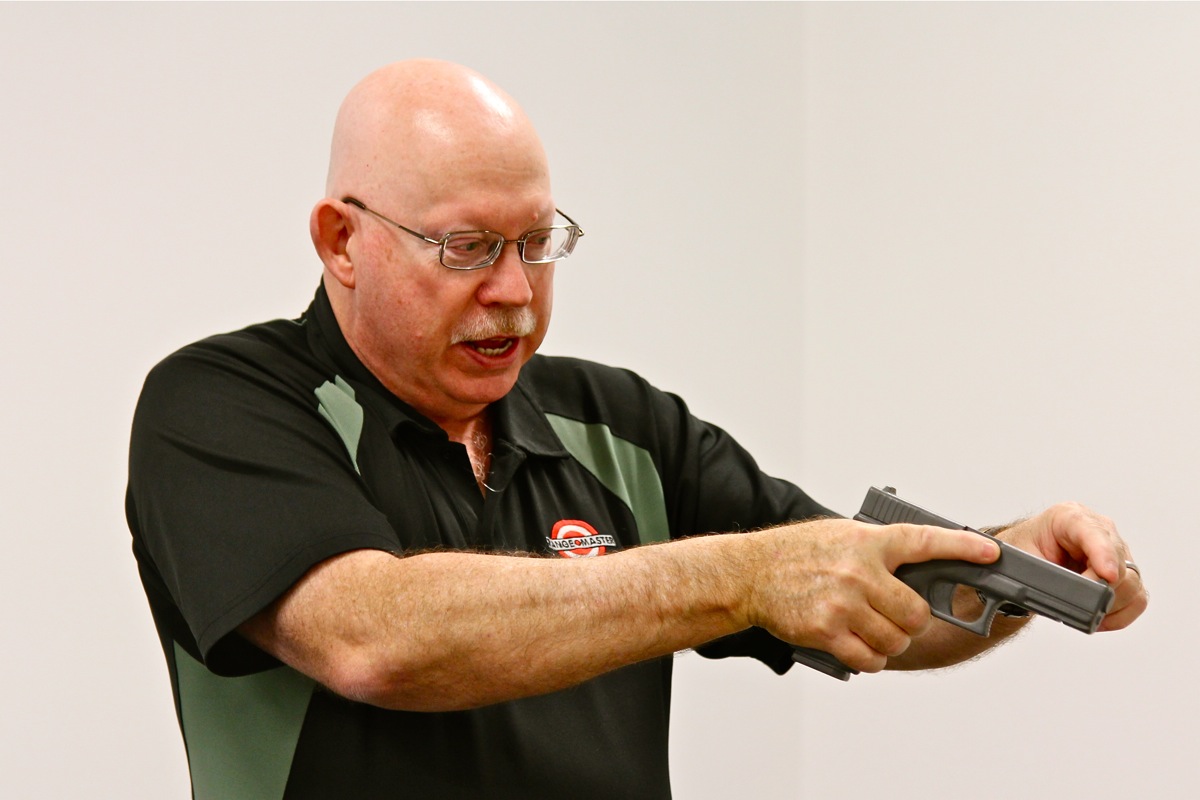
Tom Givens points out the "Bumpy thing"
   On February 23rd and 24th, I drove to New Orleans to take the Combative Pistol 1 Class from Tom Givens of Rangemaster.

The coursework is divided equally into classroom sessions covering theory (why and how) and rangework providing the practice (and instructor feedback). Tom Givens delves deeply into the fundamentals of the presentation, grip, sighting, firing and recoil management, as well has moving and drawing from concealment.

This is the off-site class taught at ranges around the country. My course was given at the St Bernard Indoor Shooting Range in New Orleans, LA.

The range is under new mangament after Katrina, and is slated to be re-opened later this Spring 2013. I took the course in February 2013 while the range was undergoing rennovations.

Why

The goal of a gun fight is to win. That means you need to shoot the other guy before he shoots you. A big part of the class is anatomy and case studies of some famous gun fights to show why shot placement is the key to shutting your assailant down right now.

Before

Although this is an introductory class, there are a few things you need before you take this class:
  1. You will need to have a pistol, holster and two extra magazines or speed loaders, and a holster for the magazines.

  2. You need to have the four basic safety rules ingrained so that you don't need to think about them. Too much is happening in class for you to be thinking about muzzle safety while trying to listen and learn a new skill.

  3. You need to know how to operate your pistol, how to load and unload it, how to field strip it and how to clean it. You'll need to clean your pistol after Day 1 so it will still work when you get to Day 2.

  4. Eye and ear pro are mandatory, but I'd highly recommend a set of electronic ear protectors so you can listen to the instructor with your "ears on".

  5. Although the course says you can take the class with a 38 caliber or other revolver, in my opinion you should bring at least a single stack semi-automatic. Most students had double stack semi-automatics in 9mm. At least one student in my class took the course with a 1911 and had no trouble. One student brought a 38 and wound up borrowing a 9mm Glock just to be able to complete the drills (you need more than 5 shots on many of the drills).

  6. I'd also recommend you bring a weapon with at least a standard length barrel, if not the slightly longer "tactical" length. Short and compact weapons would make the mid and longer range targets much harder to hit.

  7. IMHO the ideal prerequisites for this class would be
    • a basic pistol safety class, ie how to follow the 4 safety rules and how to load, shoot and unload your gun.
    • a CCW/CHL class and certification so you can legally carry your pistol in public, and
    • a basic pistol maintenance class, ie how to field strip, clean and re-assemble your gun.

    Attititude

    This is an introductory course, so you don't really need to know much about shooting your gun before you get to class. In some ways, the fewer bad habits you have in the grip, draw and trigger pull, the better.

    But it is highly likely that some or most of the people in the class will be experienced shooters. If you are new to shooting, your targets won't be as clean as theirs. Get your head on straight and know that that means you will likely learn more than they do and you'll have the easiest time improving.

    Showing Up on Day One

    You are expected to arrive for the first class with your gun loaded and holstered and your two spare magazines fully-loaded. If you normally wear your gun with "carry ammo", arrive a few minutes early, go into the range room or "fiddle area" so you can safely unload your carry ammo and load up with practice ammo.

    I got yelled at for doing this in the common area instead of the range. Lesson learned.

    Day One

    Tom introduced himself and his wife Lynn and described their backgrounds with regards to shooting.

    I always award a few extra respect points to men to complement their wives, and Tom's advice on listening to Lynn reminded me of the scene in "Top Gun" where Jester introduces Charlie and says "You'd better listen to her, because the Pentagon does."


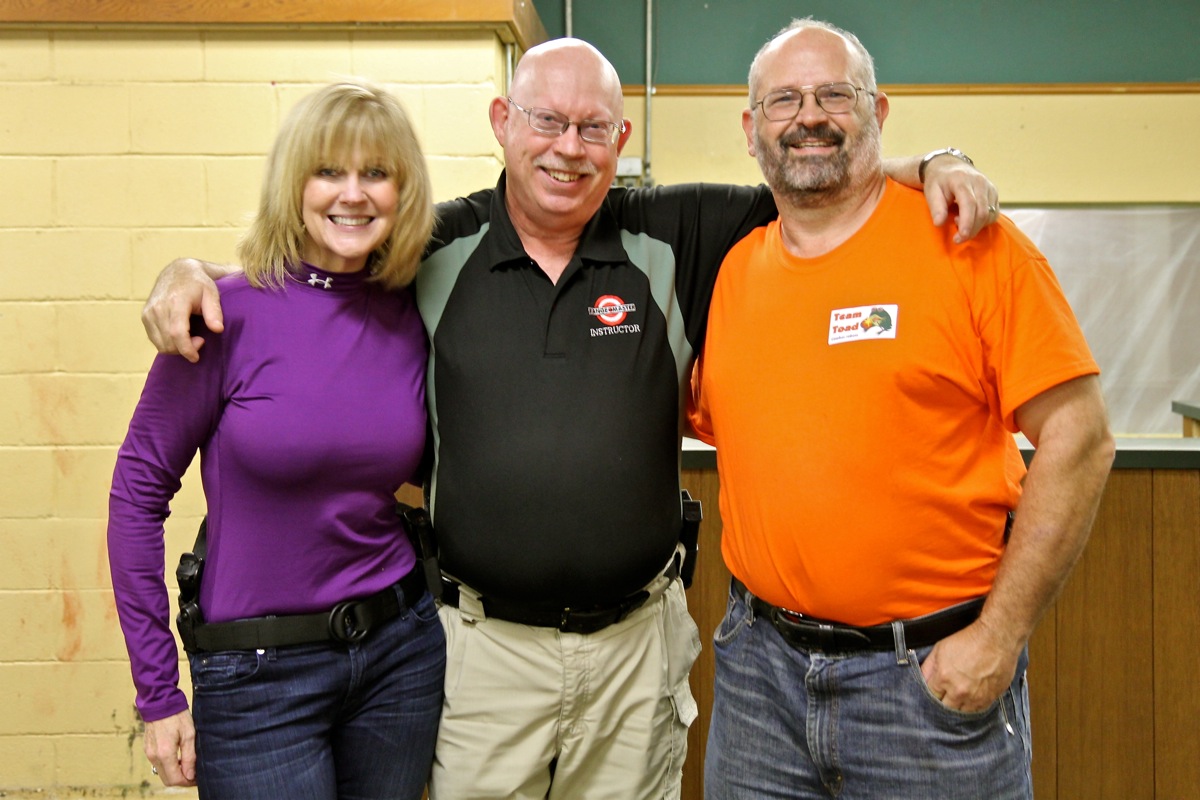
    Lynn Givens, Tom Givens and Fuzzy

    Because the St. Bernard Indoor Shooting Center was not really open for business, yet, we had a relatively small class with 7 students. Tom said that the good news was that we would each get a lot of individual attention, but that also meant that the bad news was that we would each get a lot of individual attention.

    He then described the goal of the course was to teach us how to get "first round hits". In drills we're often asked to fire X rounds in Y seconds to encourage speed, but in real life gunfights who holds the stop watch?

    The grim reaper, and he doesn't tell you ahead of time how long you've got.

    He also adressed the frequently asked question,

    "Why do you carry a gun?"

    He said that from now on, we should always answer in a clear, straightforward manner:

    "Because I might have to shoot someone."

    He addressed the four safety rules:

    1. Guns are always loaded.
    2. Never point a gun at anything you don't intend to destroy.
    3. Keep your finger straight and off the trigger until coming up on target.
    4. Be sure of your target and a its background and foreground.

    He addressed the proper clearing of a gun and explained that there were only three acceptable places for a gun:

    1. In the holster
    2. At the ready
    3. Indexed on the target

    The goal of the safety rules is to prevent the use of the words "Boom" and "Oops" in the same sentence.

    He also expanded on rule four about being aware of your target. You also need to be aware of your general surroundings before the gun fight. The best way to be safe is to:

    "Take your head out of your ass and look around."

    Language

    A note about language: people curse to express emphasis. Gun fighting is about life and death, so Tom's language is often PG-13. I barely noticed, because I use about the same the level of strong language myself. When he curses in the class, it means that something is pretty fucking important and you damn well better listen.

    Forewarned is forearmed.

    Accidents

    Accidents are caused by a combination of ignorance and carelessness. Stray bullets come from failure to aim properly. His mantra here is Yoda-like:
    We do not shoot "at" something,
    We shoot it. We must hit with every shot.

    Marksmanship

    Tom breaks marksmanship down into "fighting platform", "grip", "sight picture", "trigger press" and "follow through". He didn't address breathing except to say that it's not a factor in pistol fighting, except that if you fight properly you are still breathing after the fight is over.

    He spent the better part of on hour discussing these fundamental skills, and I won't repeat the curriculum verbatim. But after discussing numerous factors involved in establishing a proper fighting platform, he said that the two most important components of marksmanship were:

    1. sight alignment and
    2. trigger control.

    These two factors alone produce hits on target. Failure to establish sight alignment produces misses and jerking or milking the trigger produces misses, and you "can't miss fast enough" to catch up in a gunfight. With his gift for simplicity, Tom boils it all down to this:

    "Look at the bumpy thing and press the bang button."

    Presentation (The Draw Stroke)

    After discussing the proper way to hold and fire a weapon, he spent a long time in class discussing "the draw", more properly called presentation. This is the multi-step process of getting the gun out of it's holster, into a proper grip and stance, either at the ready on indexed on target.

    Again, without simply regurgitating the curriculum, I'll give Tom's pithy summary of the goal of the draw, which is speed:

    "If you need your gun, when do you need it? Right Fucking Now!"

    Tom teaches a four-step draw stroke, with holstering being done in the reverse.

    Range Work

    Towards the end of the first morning, we went into the range to practice drawing to the ready and drawing to fire. We spent a lot of time practicing the four step draw stroke one step at a time to burn the movements into our kinesthetic memory.

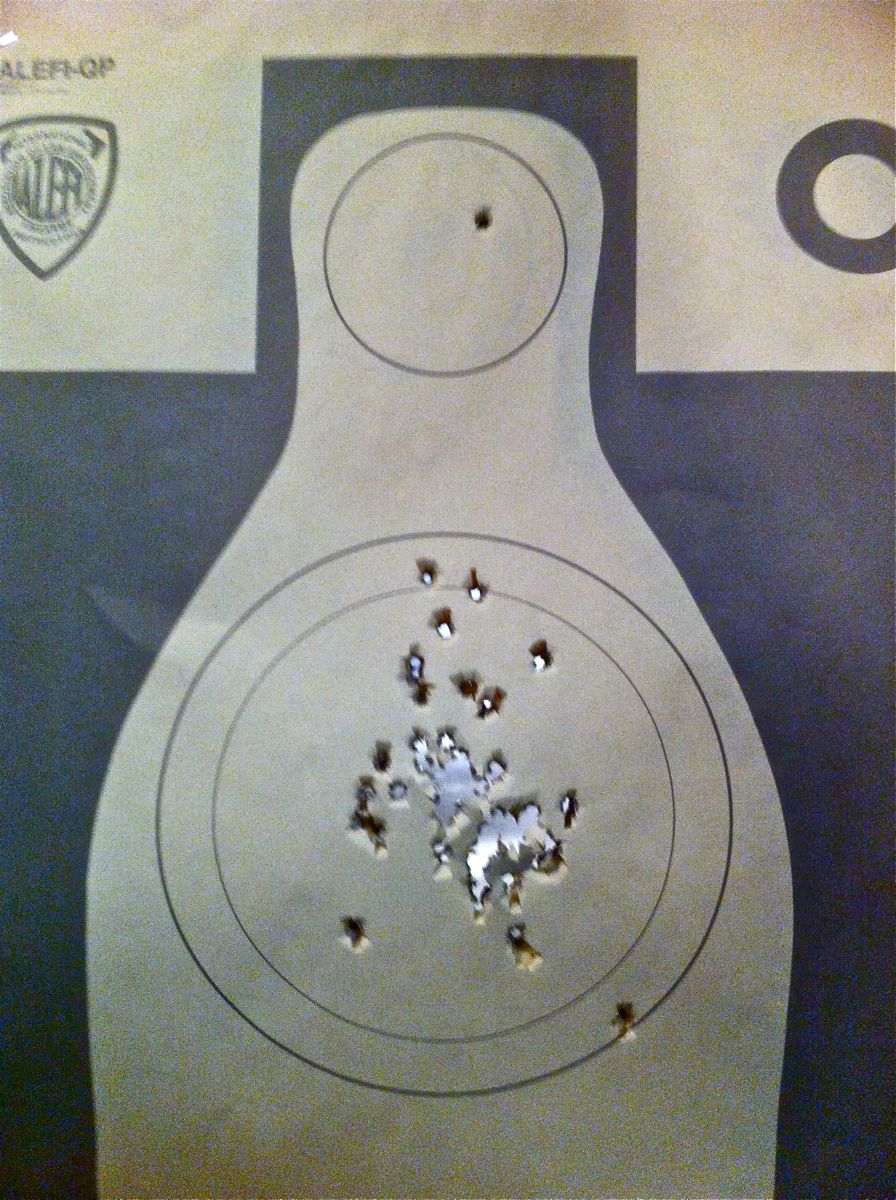
    Tom uses the IALEFI-QP target with pelvic zone, but we never aimed for the pelvic zone. Instead he uses the belt line to define the ready position. With your hands holding your gun low enough to see the assailant's belt line, you can watch his hands and be ready to react. If you're holding your weapon on a sight line to your target, your arms, hands and pistol may prevent your from seeing your opponent drawing his own weapon.

    After practicing the draw and dry firing a few times, we shot drills from 3 yards to see how well we could execute the fundamental theory we'd learned in the morning. Then we broke for lunch.

    Case Studies

    While we ate lunch we watched video case studies of actual shootings, and then after lunch we went through the scenarios in detail. One huge benefit of Tom Givens's class is a thorough discussion of real gun fights and an analysis of crime statistics. Again, I don't want to just write down the curriculum or make a YouTube playlist of Tom's presentation videos. But I will outline a few of the "take aways":

    1. Gun fights happen to people without warning.
    2. Winning a gun fight means living.
    3. The way to live is to put the other guy down quickly.
    4. People are hard to kill, so shot placement is critical.
    5. You must take the time to aim each shot. Missing doesn't help.
    6. The first shot is the hardest but the most important.

    In the movies the good guy fires one shot and the bad guy flies 20 feet through the air and lies unmoving for a long time before resurrecting like Lazarus and getting shot a second time. In reality a bad guy may not even feel a badly placed shot and you may hit your assailant several times and not even know that you hit.

    After lunch it was back to the range to work on more drills, with an emphasis on diagnostics to reveal specific problems such as milking the grip, jerking the trigger, failing to take up slack and failure to follow through with an extra sight picture after each shot. During all the rangework both Tom and Lynn would watch us shoot and give pointers on how to improve our performance.

    Tom is tough but fair. My toughest bit of feedback came after I had a flier:

    Me: Yeah, I know I missed, but I know what I did.
    Tom: I'm sure everything was just fine before you closed your eyes and jerked the trigger.

    Some guys were shooting almost all of their rounds through the same tiny hole. Tom told those few to speed up; if you can be that pinpoint, you can get good hits faster, and speed is the point. I had the opposite problem; I needed to slow down and get the sights on target and the rounds inside the circle.

    We also worked on reloads, with emphasis on speed reloads and emergency reloads. We discussed the tactical reload (AKA reload with retention), but we were told that that's a military technique that would not likely be of much use to a private citizen in self-defense.

    The afternoon alternated class work and range work so we could solidify our fundamental draw, grip, sight alignment and trigger press. Then we moved to smaller targets to learn that we needed to slow down to maintain a particular level of precision at a greater distance.

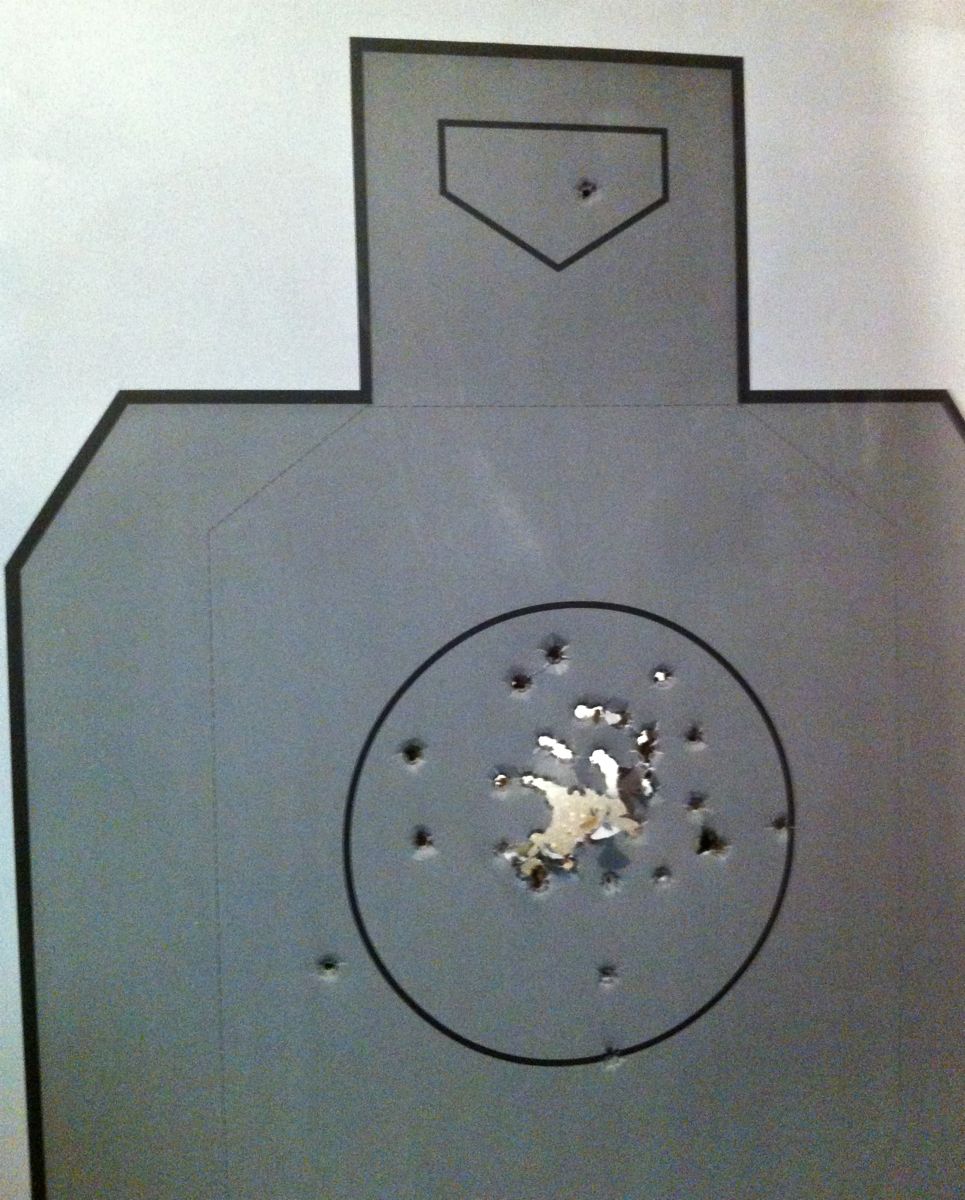
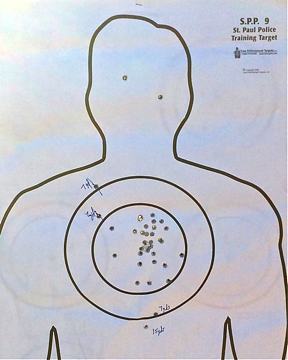
    We ended the day with a 50 round scored course at multiple distances. I was able to get the full 250 points.

      
    Fuzzy's 250/250 on Day 1

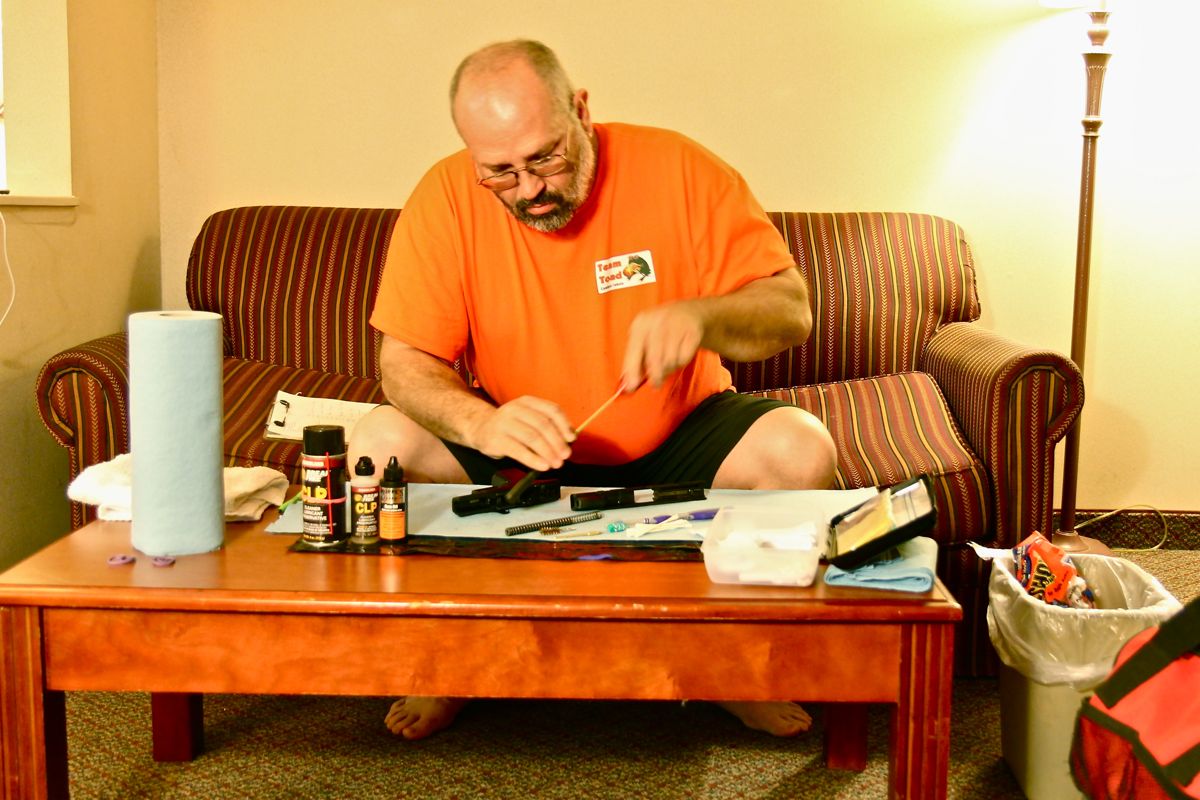
    Tom advised us to clean our guns that night so they'd work the next day.


    A clean gun is a happy gun

    Day Two

    The second day started with a very detailed discussion of the "Miami Massacre". The FBI made a very detailed study of this event, and Tom pointed out that different agents in this event were shooting at the same distances we were using for practice.

    Having seen that many of the participants in the Miami Massacre were shot in a hand or arm during the battle, we went to the range to practice firing one handed, with both the dominant and support hand. After doing more drills on the "bowling pin" target, we moved on to the DT-2A 4 color discretionary target, having to hit colors, numbers or shapes on command. After learning to draw and hit particular targets, we learned the "Casino Drill".


    Fuzzy's 248/250 on Day 2
        In this drill we start with a holstered, loaded gun with 7 rounds in it, and 2 spare magazines each with 7 rounds. On the whistle you have to hit the "1" target 1 time, the "2" target twice, the "3" three times and so on in order ending with six rounds in the "6" target. That's a total of 21 shots and you have 21 seconds to do it (with two emergency reloads).
    After doing this a couple of times, we each had to run it individually while being timed. As if that wasn't enough stress, we next simulated a gun fight. We ran the casino drill, but if you missed any target you were "out". And whoever fired the last shot was out. I went out on the second round with a miss.

    In the middle of the afternoon, we did another scored course of 50 rounds at 3 distances, including one-handed shooting with each hand. The target was smaller than day one, with an "Eye box" instead of a head circle, and a smaller target circle over the heart. I missed the heart ring with one bullet, earning only a 248 out of 250.

    Malfunctions

    After the reloading drills, we started working on clearing malfunctions and malfunction drills. Using dummy rounds, we would each set up our partner's gun with 6 live rounds and one dummy in a position unknown to them. The drill was to fire all the rounds in the gun, clear the malfunction, fire until empty, reload and fire three more rounds. The target time for this was 15 seconds. Tom called it "The Farnham Dance" after legendary firearms instructor John Farnham.

    Speaking of malfunctions, I do believe I had the most spectacular one of the weekend. We were doing a drill where we had to put 3 shots on each of 2 target at 3 yards in 6 seconds. We'd been setting up and changing magazines with the gun in the holster, and at one point I failed to latch my magazine properly. When the buzzer sounded, I swiftly drew my weapon and flung my magazine towards the target. Horrified, I pulled a spare magazine, rammed it home, and completed the exercise, putting all 6 shots on target within 6 seconds.

    Of course, Tom was behind me for this faux pas, and I got a compliment, "Nice recovery".

    Moving

    We then moved on to moving and shooting. We started simply by practicing side-stepping on step one of the draw stroke. Then we added side-stepping betweens bursts of fire and moving when reloading or clearing a malfunction.

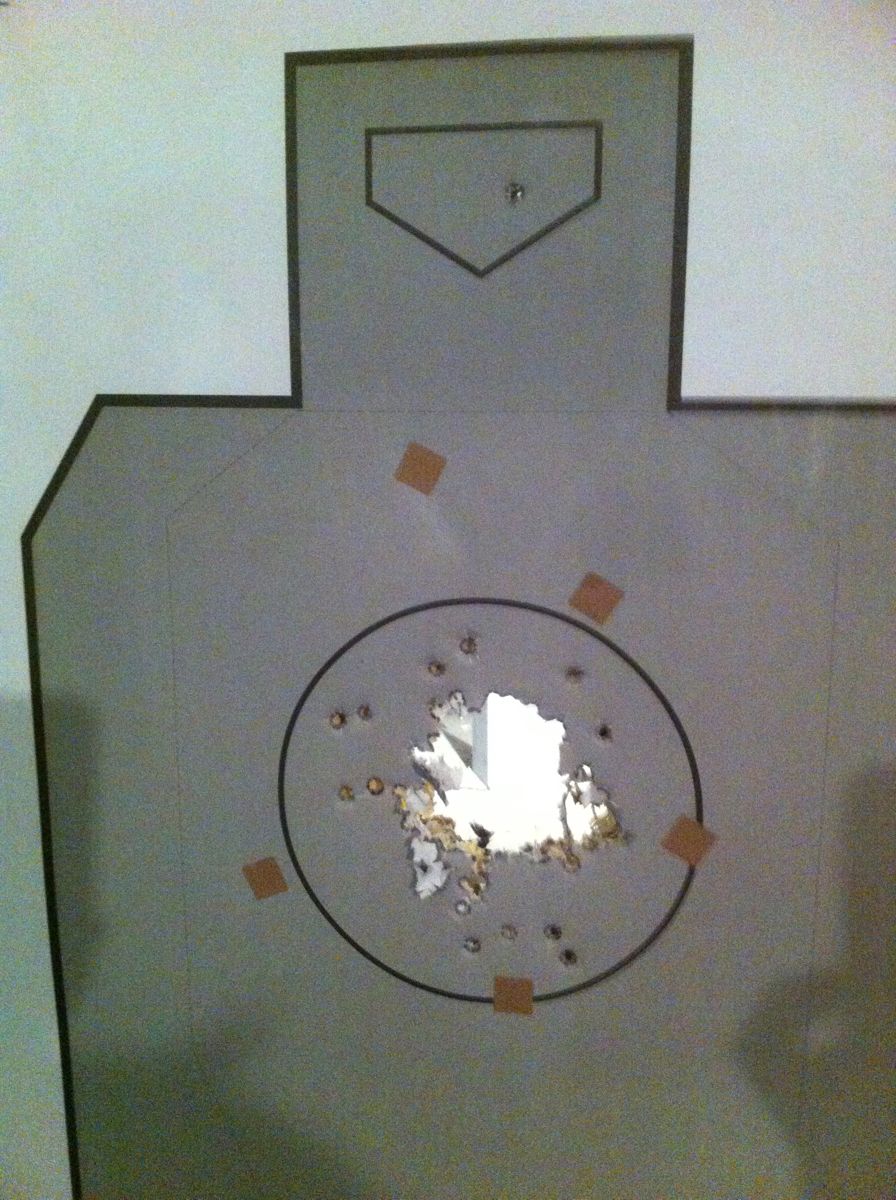
    We spat out a lot of rounds during these drills, and soon the center of the targets were just big holes.
       
    After a few hundred rounds

    Rangemaster Student-Involved Shootings

    In the next class Tom categorized firearms training as coming from a military, law enforcement or competition background.

    One unique database that Tom has access to is the details about 62 shootings involving Rangemaster students. Tom is very proud that of those 62 students, 60 "won" their fights. Sadly the other 2 cases were "forfeits". Although those two students were killed, neither of them had chosen to carry their gun that day. He exhorted us to carry our weapons, because he wants all the future points to go in the "win" column.

    Concealment

    For our last turn at the range, we put on our concealment garments and practiced drawing and shooting from concealment. Basically this just added a "zeroth" step to the four step draw stroke, either sweeping an open garment away from the weapon hip, or lifting a closed shirt hem up to the armpit to clear the weapon.


    Round Counts

    My round count for day one was 314. The second day I shot 468 rounds, and might have shot more if I had fired in all the rounds of the casino drill competition. That brought my two day total to 782 rounds expended.


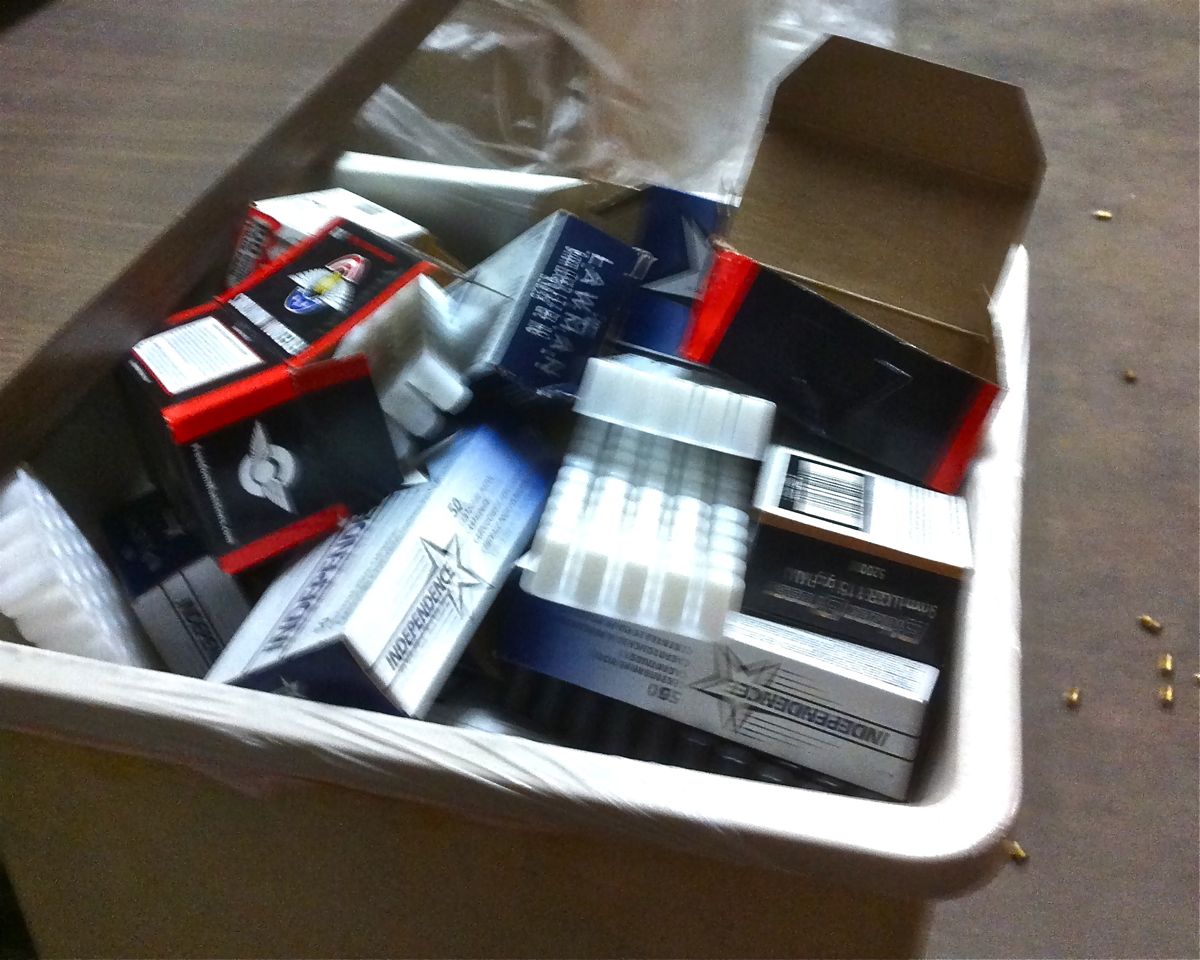
    The whole class' empty ammo boxes
      
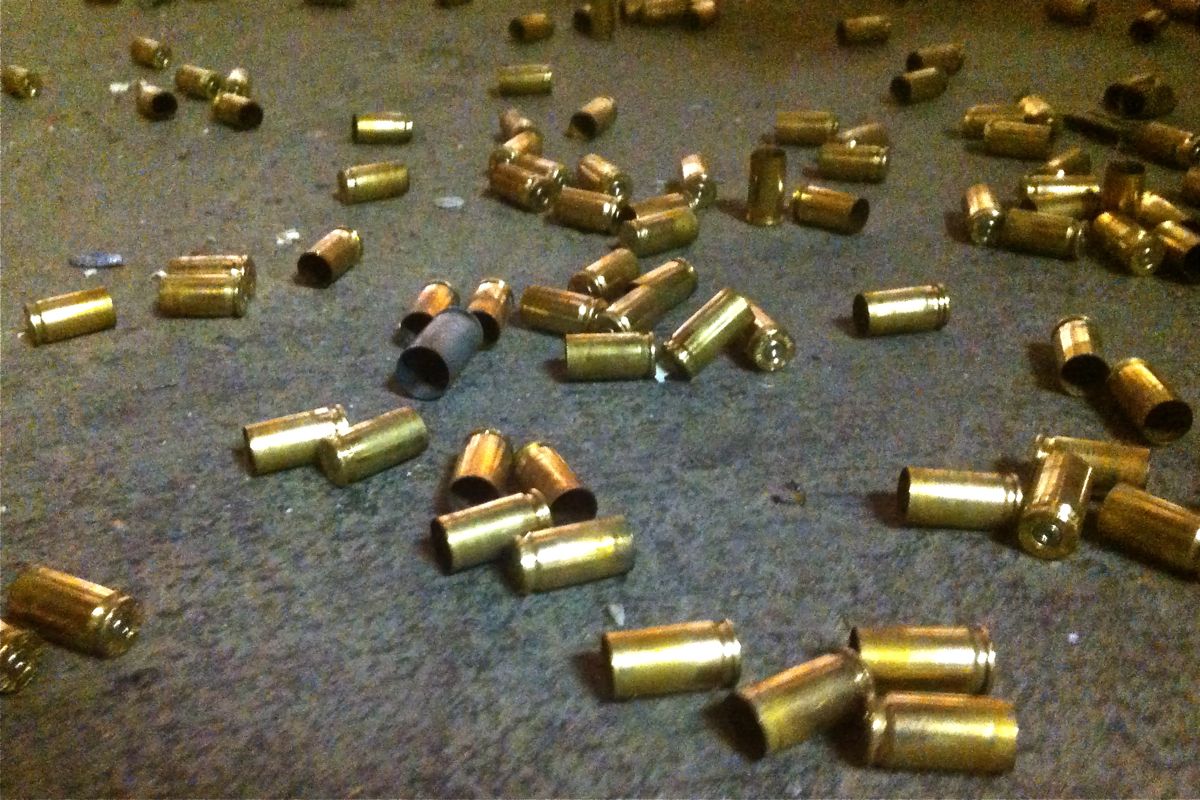
    shell casings in front of me

    Summary

    To me, the whole training program was like a rocket launch. At T-0, a Saturn V just barely moves as it lifts slowly off the pad. But gradually it picks up speed until it hits the straosphere moving at thousands of miles an hour. Similarly, Tom spent most of the first morning simply talking about how to draw, hold, sight and fire the weapon. Then in the range room we went over each fundamental skill in painfully slow detail. But once that was done, we started moving faster and faster, adding skill after skill, until by the end of day two we could hits targets at any distance out to 50 feet, drawing from concealment, moving to avoid being hit, engaging multiple targets, reloading and clearing malfunctions.

    Tom's course gives you both the theory and practice of gunfighting. But what makes it unique is his inclusion of real world case studies and medical information to explain why it's important to carry your gun everyday, why you need to practice regularly, and especially why the first round hit is so important, because you don't have time to miss.


    Epilog: Perishable Skills and the Dirty Gun Test


    After a week off, I'm only shooting
    89% at mid and long range.
       Sunday, March 3 was one week after the class, and I finally got to go out in the backyard to practice with my handgun. This was my "cold shot" test. No warmup, no dry fire, shooting from the holster as fast as I could aim, at 7 and 15 yards. I had 4 misses out of 37 rounds.

    This was also a "dirty gun" test of the Springfield XD9 (5 inch barrel). On day one of the pistol class, my gun was freshly cleaned and I fired 468 rounds through it. The ammo I used for the class was 9mm 115 gr RN remanufactured from Freedom Munitions, which worked flawlessly for me during the class.

    Rather than clean the XD9, I left it dirty for one week and then used my Fiocchi 9m 124 gr XTPHP carry ammo for this test. I'm pleased to say that the gun also ran flawlessly, with no FTF, FTE or other hangunps, both in class and on this cold shot test.

    One of the reasons I shot up the Fiocchi was to upgrade my EDC ammo to CorBon 125 gr +P JHP (COR09125). Before Tom Given's class, I was not carrying regularly. But his class convinced me to to commit to truly "every day" carry. The Fiocchi is reliable ammo, but I believe the CorBon would be a harder hitting round.

    And as soon as I was done with this dirty gun test, I went straight to my gun bench and thoroughly cleaned my XD9 before filling it with CorBon and storing it in my gun safe.


    Last updated 4-Mar-2013 Lazy Toad Ranch